Sunday, January 26, 2014

Cross Your Heart...and Hope They Lie...

                                      (source) 

There are many people in this world who believe it is their civic duty to take the world by storm and drop a bombshell of information in the name of “doing what is right.” Daniel Ellsberg is responsible for the release of the Pentagon Papers, which is one of the biggest leaks of U.S. government secrets. He was quoted in saying “It’s not that whistle-blowers believe there is no need for some things to be kept secret. It’s that they believe some things are wrongfully kept secret.” The funny thing is that it is hard to say secrets exist once someone else knows “private” information. It is also up in the air as to whether or not anything can or should be said.


Half the fun and drama in the ABC Family hit show Pretty Little Liars is knowing the numerous secrets each character is keeping from the other. The show (in the briefest description of an intricate show possible) revolves around four friends with their own set of issues and secrets they’d rather no one know. Their mutual friend, Alison, always seemed to have her nose where it didn’t belong and knew more information about each of them than any of them had hoped. She used this information to manipulate people and get things she needed or wanted threatening to expose people for who they were and what they had done. Alison inexplicably goes missing and the friends are harassed with messages peppered with information that only Alison ever knew.  The girls set out to find out who this is, why they’re doing it, how they know so much information and what they did with Alison and why. The show is based on secrets and how they usually tear people apart before ever bringing them together. It shows how secrets can be used for people, against people, to hurt innocent victims and expose truths that maybe were better off unspoken.

Secrets like this happen in real life as well. In the late 1990s, President Bill Clinton engaged in an extramarital affair with White House Intern, Monica Lewinsky. No actual, legal crime had been committed as they were two consenting adults. But a question of morals was evident as the President was seemingly happily married to his First Lady, Hillary. He had broken his vows and engaged in a physical relationship with another woman; another woman who decided to tell a “friend”. This friend, Linda Tripp, was not going to let this issue be swept under the rug. She had valuable information she felt the government and public should know.

She began recording phone calls between herself and Lewinsky. Through conversations, she found out Lewinsky had signed a false affidavit stating denial of any relationship with the president, that Lewinsky had a dress soiled with Clinton’s DNA, and that she had committed perjury in investigations concerning the President sexually harassing other female government employees. While pretending to be a “friend,” Tripp was using this information to take down the President and his administration. It had been reported that Tripp was worried the Clinton Administration was looking to get rid of her and she needed her own protection, and/or a way to make money.
                                                    (source)

This case is particular interesting as it rests on the credibility of one of the most public figures in the entire world. An extramarital affair did not break any laws; and his ability to be President, up until the story was exposed, was relatively unaffected by any information circulating about his personal life. He had maintained high approval ratings from the public, which spoke volumes about the trust given to help with issues foreign and domestic. Linda Tripp could have very well let this information go and allowed the President to carry on and perform his duties, even those behind closed doors.

It is hard to know if Tripp hadn’t exposed the truth that no one else would have come forward. In a hypothetical sense, anything is possible. Alan Rusbridger quoted Max Frankel (who oversaw the defense of the New York Times) who wrote a memo about the ethical use of leaked information. He said, “My view has almost always been that information which wants to get out will out.” On one hand, Linda Tripp could have done anything or nothing with this information. But the bigger question to ask is why did Monica Lewinsky let this information fall on unsafe ears?


                                                                                (source)


A different perspective is that of the President. After vehement denial, the proof became too solid to ignore. President Clinton could have admitted his own wrongdoings when initially approached. He could have owned up to his actions, or even lied more carefully to cover his tracks. It was only when the pressure became too much that he decided to admit that while he had been “legally accurate” in answering any and all questions, he did not volunteer certain information that gave the whole truth.


This was a heavy secret for Linda Tripp to keep herself. A public family, the nation and the world rested on this secret. If I had to put myself in her shoes, I would have to question my own motives in wanting the world to know this. Would I want to expose the President for being a lying, cheating scumbag proving to the world he was not worthy of one of the highest honors attainable? Or would I want the world to know so that I could financially benefit off of the anguish of others? How would this impact his family - Hillary and Chelsea Clinton? Would movie and book deals come my way? Would I have to legally fight to give the rights away to this story? I must admit that I am a fan of scandal and made-for-TV biopics, but I think mostly the nation needed to know its leader was not holding to his oath of office or his marital promises. It had to have been incredibly hard for the Clintons as a family to deal with something so mortifying while the world looked at them under a microscope, but this was a secret that was only going to be halted in its tracks if someone forced it that way.

                                                     (source)

Of course, in the 90s, exposing secrets was a completely different ball game than it is today. The three-sided coin of this story, Bill Clinton’s side, Monica Lewinsky’s side and Linda Tripp’s version, all had to be deciphered individually through different messages given to the public. All messages given to different news outlets with different biases and different motives. There was little room for social reaction on the level it is today with social media and its instant access to information. On top of worrying about public reaction to the scandal itself, I would have to worry about my own reputation. And I am not at all sure which Saturday Night Live actor/actress/guest star would play me in the satires of this salacious story.


Linda Tripp attempted to take it in stride. It is hard to watch yourself be made into a fool on a show like Saturday Night Live, and be ridiculed not only for what secrets were exposed, but as a human being as well. Tripp's appearance was the prod of many jokes and her looks after having plastic surgery were poked at as well.

As a media professional with a story this high profile, it is hard to say if there is a way to NOT be entangled in the story. I myself may become part of the story just like Linda Tripp did. I think a job that revolves around scandal, is an inevitable fate. It must be taken with the territory. It can make or break a career...and a life...

                                                  (source)


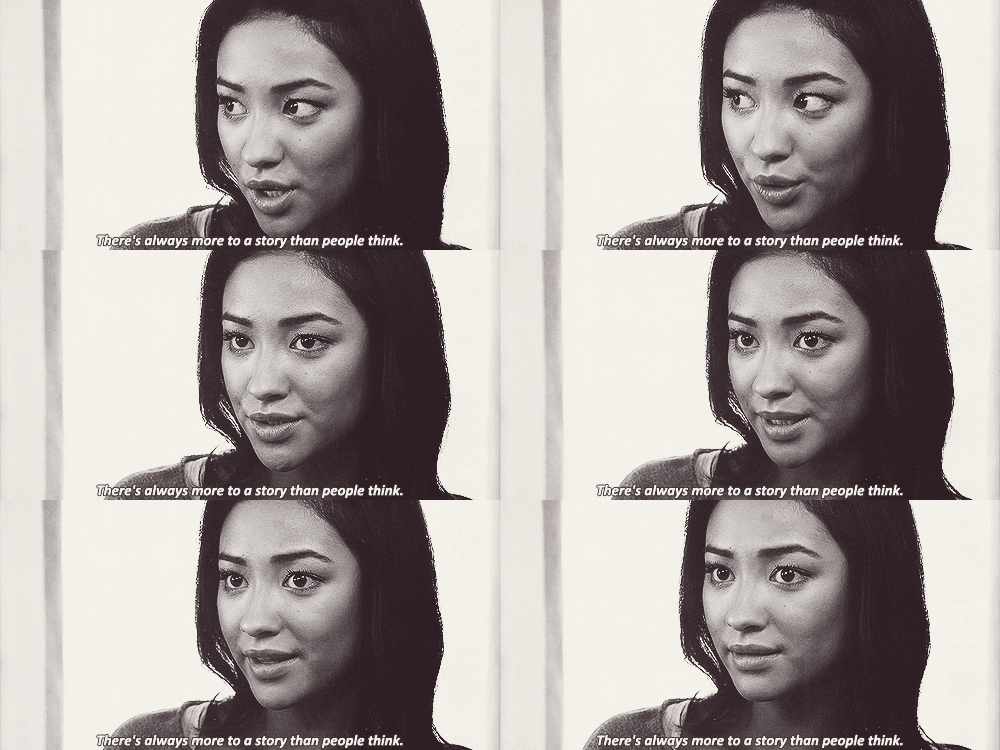
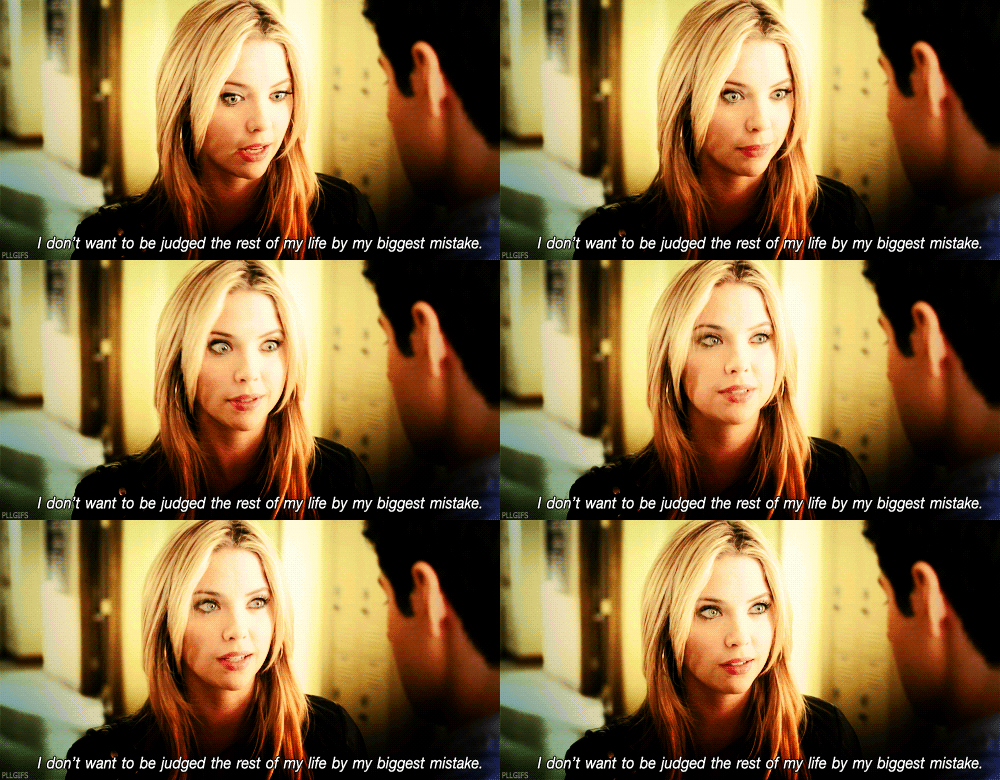
Whether it’s a dramatized series, or a real-life drama, everything has different sides to weigh in on. In Alison's case in Pretty Little Liars, she may have considered keeping her mouth shut and nose out of other people's business and perhaps she wouldn't be "dead" (SPOILER ALERT: she's not actually dead). Her friends could have been less afraid of her and helped delve into why she acted the way she did and found out who/what she needed protection from before any of the mess even began. The story is still moving and is anyone's game at this point. Without the secrets and betrayal, there would be no story.

                                                (source)

In the case of Linda Tripp, honesty and betrayal go hand-in-hand. She could have easily forgotten any of the President’s scandal had ever happened, she could have made things worse for herself and others by blackmailing them to reveal their own information, or she could have done exactly what she did, which was open up about everything she knew happening behind closed doors. Monica Lewinsky could have salvaged enough self-respect to keep from being “the other woman,” she could have confessed and signed a true affidavit citing her relationship with President Clinton, she could have continued her affair and never told anyone, she could have confessed to Hillary Clinton alone, or she could have exposed Bill Clinton as a monster and played herself off as a victim. The President himself could have upheld his marriage vows, could have been forthright with information when pressed for it, could have completely lied about the affair all together or could have come up with a better strategy that would have kept him from getting impeached. Whatever x, y or z combination that could have come from this all falls back to Frankel’s words that information that wants to come out, will come out. And come out it did.

                                                      (source)

Sunday, January 19, 2014

Maybe YOU'RE the Bunghole...


Understanding what is right and what is wrong is a difficult concept. A majority of the time, we need an example of one to understand the other. Understanding what is, many times comes down to knowing what isn’t. Behavior, actions, ideas and concepts are often never regarded or praised when they are right. Society as a whole is only quick to jump on what is wrong. Many base their own actions off that which they see others doing. Having someone or something to point the blame at suddenly seems to justify the actions of others. Even as adults, many like to pose the almost childish question to society of “well, he did it, so why can’t I?”


Creator Mike Judge made the show, Beavis and Butthead based off teen awkwardness and angst merely for entertainment purposes. He wanted to rattle the cages of the politically correct and give viewers some dumbed-down humor to laugh at. Quickly, illegal activity, immature catchphrases and wheezy laughing became a societal joke. Unfortunately for some, the joke was on them.

Aaron Messner was only five years old in 1993 when he set fire to his trailer, ending the life of his two-year old-sister. Authorities later came to find out that the two cartoon ne’er-do-wells, Beavis and Butthead, inspired his antics. This was the first case in a long-line of pranks that were blamed on the Viacom top-rated show. MTV denied any causal links between these instances, but worked with the network and media backlash to help prevent future occurrences (or perhaps, future accusations).


This particular case study is an excellent example of Communitarianism in ethics. This code focuses on the actions of society on the individual and vice versa. There is a back-and-forth of how individuals’ actions affect society and how society can in turn affect other individuals. Communitarianism seems to place a high importance on society looking out for its own. Ensuring we give all people the resources and influence necessary to become and remain upstanding citizens lies within the citizens themselves. In the case of Beavis and Butthead vs. the riff-raff of America, two two-dimensional and animated individuals seemingly “caused” multiple house fires, the killing of a cat and a bowling ball falling off an overpass onto a moving car below. The people who committed these actions pointed the finger at a show saying that it was good enough for them, so why couldn’t they do it too?

Who in the community is to blame is a question that may never be answered. Should the community over the guilty individual receive some punishment because of external influence, is a tough question as well. In this particular case, Mike Judge the creator did not tell these people to light the matches or throw the bowling ball. Viacom did not condone people committing violent acts against each other either. But before these incidents occurred, the media company did not put any disclaimer on the show discouraging these actions either. Neither Beavis nor Butthead had a moral compass to guide them, and apparently these viewers didn’t either.


Lawrence Kohlberg mixes ethics of justice with stages of moral development. As we grow up, we exhibit certain levels of reasoning. Children often act out of self-interest and need adults to teach obedience and consequence in order for these moral lessons to stick. We all grow into conventional levels of reasoning and understanding to shape how we view our actions and society around us. It then comes to a point where we must realize how we as individuals are a part of, as well as mutually exclusive from, society all together. In Aaron Messner’s case, he may have been old enough to understand his actions may hurt people, but not old enough to understand that until after it was too late. Can we blame little five-year-old? Should we be asking where his parents were during the viewing of Beavis and Butthead? Is it more, or less, important to ask where they were when he was in possession of something to cause a fire? Was there really a fault on MTV’s part for allowing the show to come on during a time a five year old is potentially watching TV around 7:30 in the evening? Who ultimately lacked the levels of proper reasoning? Anyone can answer this question with his or her own opinion, myself included. But it will never be more than opinion; it will never become a fact or an absolute.

Immanuel Kant’s Categorical Imperative is an interesting take on this case as well. Kant attempts to see if there are in fact any absolutes in morality and ethics. We can cheat on a test even if we know it is wrong, or we can simply not cheat at all. Our autonomy allows us to make choices even if they are perhaps not in a particular party’s best interest. Anyone has the ability and free will to throw a bowling ball over the side of a bridge onto a moving car. But should that person feel bad for doing it at all, or only because the life an infant was taken as a consequence of this person’s actions? Can we more-so blame the driver of the car for being in the wrong place at the wrong time, or swerving the car causing the death of a baby passenger? These questions fall under the idea of determinism: A caused B, which resulted in C making A true because of C. With this, you can also argue that will does not have total causal power and that an outside influence has to have caused this causal chain. Would this person never have had the idea to throw a bowling ball had they not seen the show? Or is it simply easier to blame Beavis and Butthead?


It may be hard to say what is most helpful in answering any of these questions. My own personal moral compass has been oriented to point directly at myself as the cause and blame for my own actions. It is hard to remain unbiased in this case in allowing the idea that external forces are to blame for ridiculousness rather than the free will and reasoning to understand the consequences of these actions.  However, breaking down the different codes of ethics and understanding where someone may get these ideas and notions is an interesting way to broaden the horizons of decision-making. There are always two sides to every coin, but which side it lands on can make a world of difference.

**all images are active links from their source**

Saturday, January 11, 2014

Taking Your Word For It

Even from a young age, the idea of wanting to trust and being skeptical is ingrained in our minds. Watching Reading Rainbow as a child always ended with children talking about and suggesting their favorite books to viewers. However, each critique always ended with "But don't take MY word for it..." 


In today’s age, we tend to see humans and humanity as two very different and yet similar ideas. Upon meeting someone, we like to give people the benefit of the doubt. What they say about who they are, where they come from and what their opinions are becomes the basis for how we understand human behavior as a whole. Collectively, we are all quick to judge that society as a whole, or even no one in particular, has something up their sleeve and perhaps a hidden agenda that only works for their own benefit. Media is often seen as a mix of faceless corporation and the faces of leaders, spokespeople and journalists. The ideas of who or what can be trusted are blurred and confusing lines.

If I lived in my own fantasy world, my dream job would be sitting in the comforts of my own home being a blogging critic. I would love nothing more than to add some comedy, sarcasm and pithy text to my opinions on news, products, ideas, television shows, and businesses to be regarded so highly that I could make a living off blogging about them. However, with opinions comes skepticism. Deni Elliott wrote in An Introduction to Ethical Decision Making how media myths can fog a consumer’s view of ideas giving reasoning behind why all opinions are NOT all equally valid, that coming up with a right answer to an ethical issue is nearly impossible and that self-interest almost always trumps the idea of ethics. Readers would often wonder how much they can trust my opinion as a consumer that they have never met. They would question whether or not I was perhaps paid by the company to give them a good review. If too many negative opinions are given in a row, my (fictitious) blog could be seen as the place where products and shows go to get slammed and burned forcing a company to decide whether or not to take action. Bias is a fine-line and readers would become less interested in a person, or me, if they felt they have less in common with what is presented to them.

In the second chapter of Media Ethics by Patrick Plaisance, he quotes Milton Rokeach in saying that ethics is a “particular mode of conduct or that a particular end-state of existence is personally and socially preferable to alternative modes of conduct or end-states of existence.” On an individual basis, we want to believe that people are telling us the truth. We see their face and they are looking us in the eye and we have little choice but to put faith in their words and believe them. When these faces or groups become a third-party mix of capitalism and greed, it is harder to give as freely of this faith.  Plaisance also says “which argument you endorse will largely depend on which values you feel should be given greater weight in this case and the quality of your articulation of the reasons why this should be so.” If I were to actually have an opinions blog, the opinions themselves would be secondary to the delivery in which I would give my reasons behind why I felt my opinion mattered.

Credibility and popularity in this case would walk a fine-line in helping people trust my opinions. In the same Media Ethics chapter, it states “If a communicator is believed to be deceptive or dishonest, unconcerned with others’ welfare or oblivious to everyone’s obligation to use media in a socially responsible way, that communicator provides potential audiences with little or no compelling reason to pay attention to his message.” Knowing this person can be trusted is the biggest piece of the puzzle.

Recently, a court ruled in favor of a journalist who had refused to reveal her sources to lawyers about information obtained about Aurora, Colorado shooter, James Holmes. This is a perfect example of knowing credibility is at stake and making a case against a violent killer. The television channel, A&E, was recently facing a dilemma concerning one the stars of their hit show Duck Dynasty. Coming from the extremely conservative roots of the south, star, Phil Robertson, was quoted in coming out against gay rights. 


The Internet took this story by storm with social media users giving opinions on whether or not the show should be allowed to continue at all, continue with or without him, or whether he had any right to give his feelings on such a socially sensitive topic. Journalists, columnists, bloggers and social media users alike rallied around this story. The ethical argument about whether he was within his constitutional right or was abusing his fame for his own agenda became a highlight story. Opinions are taken into account on an individual and whole basis and the average reader no longer knows where exactly to turn.

During my undergrad career, I took a semester-long program at American University focusing on journalism. The two biggest topics covered were the plentiful career opportunities as well as the ethics behind creating compelling content. We discussed journalists’ abilities to alter and manipulate photos and quotes to create a story they deemed worthy. It is interesting to see how far media will allow a story to go before it is decided it is unethical.


Since there is no right or real answer, it is hard to say where the proverbial “line in the sand” can or should be drawn. As this current class in Media Ethics progresses, I look forward to hearing and reading more about individual case studies that fight our beliefs in ethics and morality and how it influences public opinion on news, society and the world as a whole.

Sunday, November 24, 2013

Crisis and the Community

The more research I look into on Heather Armstrong and Dooce.com, the more powerful and amazing I see blogging to be as a means of a lifestyle and career. It’s challenging enough to come up with compelling content in order to keep a constant readership engaged, entertained and willing to come back. For so many, that’s where blogging begins and ends and seemingly why other blogs have not taken off the way Dooce has.

When you’re a blogger like Heather Armstrong, your business and entrepreneurship is a totally different ballgame than that of a corporate entity, but many characteristics coincide. Corporations all report to their directors and shareholders who have invested a great deal financially in the success of a brand. For blogging, advertisers invest a great deal of money into the writer knowing and seeing the emotional investment readers take into the content of such a site. 

Rohit Bhargava wrote an interesting chapter on blogging in his book, Personality Not Included. The chapter focuses a lot on how beneficial a blog can be for a brand. Though the Dooce brand is a blog, many of his suggestions and guidelines ring true to Armstrong’s successes. While in all the time I have been reading Dooce, I have never seen any posts directly looking to involve government entities; though Armstrong makes a great effort to keep her blogging on a consistent schedule attempting to post at least something each day.  Should be away from home on a business trip, she makes her readers aware of why the posts will be few and far between and when she is expected back. As a woman who blogs about family, it is little details like this that make her readers feel as though they are a part of a bigger familial circle. She makes her readers feel like an extended family not only related to her but also to each other.

Her blog posts consistently have links to previous posts, sites relating to various topics and pictures that create an intense visual for her platform of each entry. She promotes her content by many times promoting something else – usually linked to sponsorship deals. Overall, Heather Armstrong and Dooce.com do well for themselves reaching and appeasing those who are invested in the site both financially and emotionally.

If previous gushing wasn’t proof enough, my favorite part of the site is the Dooce Community forum. Any questions anyone can think of are usually asked from “what’s going on?” to topics relating to life, death and everything in between. In order to reach out to readers and give them this amazing open space, there are very clear and succinct Community Guidelines all readers and writers must follow in order to keep the forum as genuine and welcoming as possible.

community.docce.com

Armstrong herself and her personal assistant monitor the site, but she also has brought on some of her most loyal readers as moderators to keep reigns on the flow of information shared on the site.  The guidelines make it very black and white to readers that this online space is for entertainment and Internet camaraderie. It has been tried various times to point out that each topic brought up is to be posed as a question and all other topics should be formed as group pages to keep from too many people posting about similar ideas. Unfortunately, this is not always the case and the Community is littered with statements and opinions rather than questions and answers. The moderators have done a phenomenal job lately of keeping this issue at bay. If they can continue this, the Community will only increase in awesome-ness.

These strategies Armstrong has taken on to keep Dooce the success that it is, has not stopped even in times of hardship. For a brand like a blogger, crisis management usually revolves around the life and times of the writer themselves. Heather Armstrong has made her enviable fortune chronicling her life. She has willingly made herself vulnerable to the public in hopes of making sense of her own struggles and being able to reach out to others in need. She wrote a book about the scary, dark times in her life dealing with post-partum depression after the birth of her first daughter, Leta. She was always open about the amount of work she put in to make her marriage work. But the biggest shock of all was when she first announced that she and her husband were separating in January of 2012. 

Heather Armstrong Announces Separation on the Today Show

While it was a personal crisis for her, it became a crisis on many levels for her online life. Many readers wondered and speculated what could have happened and why so little was being said to the readers. A majority of readers respected when the Armstrongs announced officially that they would be divorcing and that no other details would be spoken of publicly. Loyal Dooce fans knew that Heather Armstrong had a history of mental health challenges along the way and worried about the fate of her site – would she stop posting for long periods of time? Would readers ever hear about what happened or what the final straw was that ended everything? What does this mean for the future of their family and the future of the Dooce business – one so centered around the nuclear family unit? Armstrong’s strategy to deal with this crisis was on point. She did not deny or skate around the issue. She addressed it head-on giving out as much detail that was mutually agreed upon between her and her soon-to-be-ex-husband. Much like her time suffering with post-partum depression, Heather Armstrong used Bhargava’s technique during this most recent family crisis to forge relationships with other bloggers and readers creating a communal fellowship to lean on outside of her real-life relationships.


As a blogger, your life is your living. When you’re up, your blog is up. When you’re down, it’s a toss up finding out how the public will respond to your news. In Dooce’s case, her most loyal fans were right beside her just like they would be face-to-face if given the opportunity. Her readership is her community and she has given every emotion possible to keep people invested in wanting more in the day-to-day life of Heather B. Armstrong.

Sunday, November 17, 2013

The Six Degrees of Media Relations

A powerful woman who runs her own business is an inspiration. Heather Armstrong has taken Dooce.com and become one of the most popular and revolutionary bloggers in today's world wide web. She has made a living off of being herself and writing about her life. While it would be fantastic to say she has done it single-handedly, it is clear that even the best of entrepreneurs need the help of various media to get their company, its message and overall source of revenue off the ground.

Sonja Jefferson and Sharon Tanton wrote Valuable Content Marketing discussing ideas on how the content from a company, given to the public, initializes conversations, interest and public opinion. It is mentioned in the chapter What is Valuable Content and Why It Wins You Business that what is said and done will resonate deep with consumers. 


For Dooce, her voice is her content. Her blog posts are the bread and butter of her life. Her media relations strategies are different than that of a Fortune 500 corporation or even a traditional company. Media is how she relates to people. In partnership with many of her advertisers that help keep her site financially stable, Armstrong often writes posts on her own family and personal life relating them back to a promotion with said company. She has been the catalyst for many advertisers in giveaways and promotional tools. It has been a win-win for these companies, Dooce.com and the readers all relishing in the talent of her written voice and compelling nature. She has taken to promoting her site through other forms of social media and through television interviews as well. She keeps not only Dooce.com relevant, but keeps Heather Armstrong relevant as a blogger, entrepreneur, woman, mother and overall person.


Dooce.com’s brand speaks to its overall purpose. Heather Armstrong, a simple woman who moved to California in her early adulthood, started a blog to keep her family up to date on the happenings in her life. In the YouTube video above, she states that the name of the blog came about by accident as a typo every time she went to type the word “dude” to her friends through Instant Messenger. She made the mistake of speaking negatively about her company and coworkers on this site and got fired for this very blog. She never dreamed her site would morph into what it has become. Her brand started as a mistake and is a mix of many things and she keeps it that way to further the symbolism of her constantly changing life, most of which usually comes about by accident or chance. 

In a reading by Frank Rose, he suggests the true power of Milgram's theory of six degrees of separation. With the complete connection of links, friends, followers and subscribers online, the separation can often time seem even less than that. At about the 2:50 mark in the video, Heather discusses the power of her site to influence other companies and their treatment of its customers. In an attempt to get her washing machine fixed, she was having little-to-no luck finding a way to get it fixed in a timely manner. After much understandable frustration, she warns the customer service representative of the number of Twitter followers she has and her willingness to speak out against their company. With her six figure number of Twitter followers as well as blog readers, she found the upper-hand against corporate jargon and policies and showed the world that social media and its connection to others on the web makes a difference. (WARNING: The blog entry hyperlinked above is **long** and sprinkled with colorful language - but a very worthy read)

Heather Armstrong partners with advertisers, writes books, publishes her photographs online and even sells photos of her dog in a yearly calendar. She also sits on the Board of many women-centric organizations and keeps herself and blog alive through keeping the Dooce name in people’s minds. She has done a successful job of this as last year she was ranked #26 on the Forbes Most Influential Women in Media list. With a blog as diverse as hers, the target audience is a wide range of readers – both male and female, mother and the childless, emotional sufferers and those who look for a good laugh. She finds new and interesting ways to maintain the readers she has and hopes to bring in new readers. Since the YouTube video was posted last year, her number of Twitter followers has expanded even more.

In the future, it would behoove Heather to chronicle her efforts and stories focusing on her philanthropic efforts. Right now, Heather is in Haiti with the Every Woman Counts organization, of which Heather is a Board Member. Founded by former Calvin Klein model, Christy Turlington Burns, the organization works to end preventable deaths from pregnancy and childbirth. Armstrong has mentioned it on her blog a few times but has never really taken the opportunity to use the power of her blog to help the mission of this organization. Especially with the addition of the Dooce Community open discussion forum, so many other readers can add their two cents and social media power to make this organization even bigger and more successful than it is now. While it is great to enjoy the humor and emotion behind the life of the Armstrong family, there is a missed opportunity to show how much stronger women (and mankind as a whole) can truly be when they rally together to help one another. This can only increase success for the Dooce brand as well.


It is important to see entrepreneurs thrive. All companies started from the bottom before they can become a full success. Heather Armstrong and Dooce.com have seen many ups and downs but have never shied away from making them public. The future is bright for this blog so long as their media relations continue to grow.

Sunday, November 3, 2013

The Story IS the Brand

Frank Rose wrote a book called The Art of Immersion discussing storytelling and difference in the medium used to get the story across. He wrote in Chapter Three of the book, “Some people have stories that are too big for the Internet to handle.” Heather Armstrong of Dooce.com uses her site to disprove Rose. If I could put words in anyone’s mouth, I would say that Armstrong would tell Rose that the Internet can watch out, because her story is grand and she’s coming to tell it.

I also came across an excerpt in Rohit Bhargava’s Personality Not Included that discussed how brands could use specific characteristics to make themselves a success. Any brand, that does their work right, pulls a magic trick before a consumer’s eyes enticing people without them ever realizing the tremendous amount of work that goes into making everything look seamless and easy. The most successful of these brands, have the right people who have innate characteristics to make this happen too. Armstrong is just that person for Dooce.com.

Bhargava mentions an interesting concept that is key to a successful brand. The UAT Filter has three features that work together to make a brand stand above its competition -Uniqueness, Authenticity and Talkability. Uniqueness, as we know, is what sets us apart from others. Dooce.com is not just any blog. While many think that their blog is the most interesting place on the web, they take to the Internet to talk about the food they eat, the manicure they got and funny animals they watch on YouTube. Dooce takes her everyday life and attempts to make it fascinating (Personally, she can talk about a sandwich, mix it with her quippy sarcasm and anecdotes about her previously Mormon life, and somehow make a picture of a sandwich the most delicious thing I have ever consumed without ever actually tasting anything). Armstrong has a personality that she brings alive online which is why she is leaps and bounds above so many other bloggers in terms of success and business. She started her blog during a time when this was a relatively new way to communicate. She also started the blog as a way for her family to keep in touch with her and the events of her life. She did not initially start the blog with the intention of it being her full-time job, but because of the way her life unfolded, everything fell into place in a very unique way. She positioned herself because of the twists and turns of her life and found international friendships with readers from all over the globe. Armstrong wants her readers to see her life from the outside in. It keeps her blog entries and overall site the authentic location it has become.

She is a woman all her own and stays authentic to her original message. She never shies away from being herself and remaining an open book about her life and business as a full-time blogger. Readers come to her site to be entertained and get a feel for a woman and family they would otherwise never have known. She creates a credible brand for her life by writing about relatable content. Many mom-readers understand the hardships of raising energetic daughters with opposite personalities. Many former Mormons understand her life raised in a religious setting; and many find humor in her feelings toward her upbringing today. A lot of readers love to hear about the people in her life as well. Her assistant, her kids, niece and nephew, and the friends who share in the process that make Dooce.com happen help all readers see beyond the humor and the emotions behind her blog posts and create an environment that promotes a relationship of connection, friendship and conversation.

dooce.com

One of the top things about Dooce.com that is different from all other blogs is the Dooce Community. The message board is one of the most interesting places on the Internet. No question is ever off-limits and no answer is ever too ridiculous. Many who post on the site have commented on how they ever came across the site in the first place. Before Search Engine Optimization was the monster it has become, finding Dooce.com came from others talking about it. Blogs would link to Dooce; articles would discuss Dooce; Heather was seen in video forums like Momversation or working with TV channels like HGTV. She took her brand and site and made it more than just prose. She made Dooce a roundtable conversation.

Knowing how to use the UAT filter without any cognizant knowledge of it, Dooce has become more than just what it once was. Dooce could take a hard look at itself and make an onliness statement along the lines of Dooce.com is the only site that brings a myriad of everyday experiences and mixes it with open conversation, fun products to buy and the ability to maintain a sense of humor in all situations.

On top of the site content, one of the most fun aesthetic parts of Dooce is her recently updated website look. Instead of entering Dooce.com and seeing mostly text (as you would in most any blog), she condensed her blogs into large-scale thumbnails including pictures and captions to entice readers to read more or allow them to skip over the entry and skim through material they may find more scintillating. She also changes the site’s look monthly with new webpage banners. Every month, she creates a new look at the top of her site to signify a new part of the year. She keeps an archive on her site of past months to see all the fun designs throughout the year. In each banner she includes the Dooce logo which is a funky font with each letter a different size and the logo is large and all over the place. This is very symbolic of Heather Armstrong. She is always open about her life, but never attempts to suggest that she herself has it all together. She seems to credit her success in admitting to being imperfect. She unifies the good and the bad by aligning herself with her writing and showing us her brand is as human as she is as well as her readers. On top of the UAT filter, there are other personality traits that make for a successful brand including soul people and passion. Dooce is most definitely not lacking in any of these areas.

dooce.com/category/mastheads

Heather Armstrong and Dooce.com are sometimes mutually exclusive and often times one in the same. This really encapsulates the site a reader enters upon coming across the blog. You would be leaving a lot on the table by not checking out her site. Her story is her life and it is one to worth getting to know.